


The atmosphere at the South Australian Science Teachers Association (SASTA) 2026 AGM Conference was electric. For two days, as the Gold Sponsor, we joined a community of dedicated Science, STEM, and Physics teachers, ranging from those just beginning their careers to seasoned Heads of Departments, all united by a single goal: sharpening professional development through connection with industry-leading technology.
At our exhibit, the focus was on the practical, curriculum-aligned application of immersive tech in the modern classroom, and yes, the "wow" factor too.
The Tech Stack: Portability Meets Power
To demonstrate how easily immersive learning can be integrated into any school lab or classroom, we brought a high-performance hardware suite:
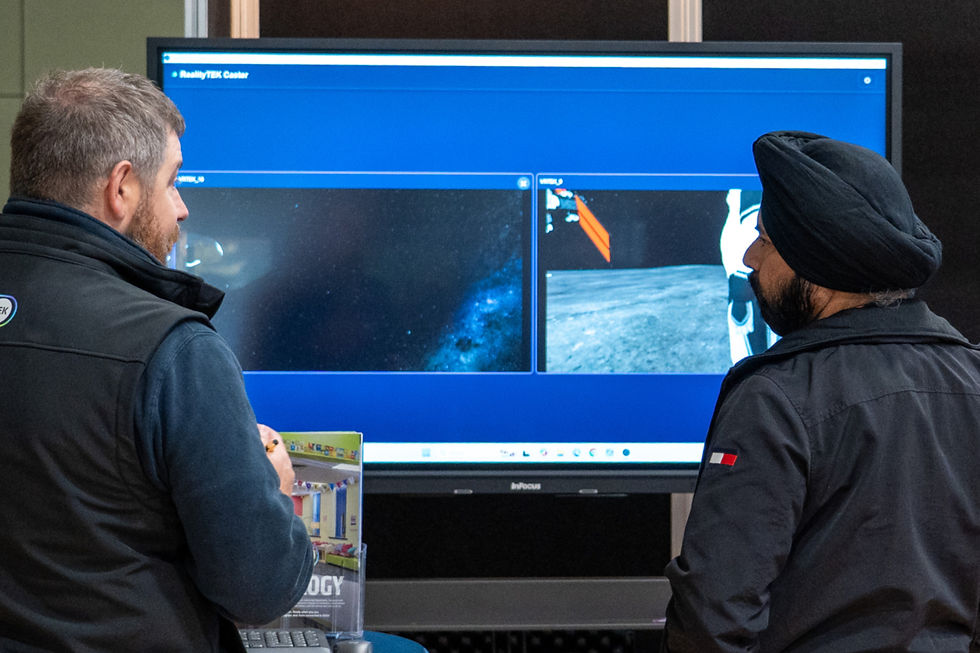
Infocus Interactive Display on a Mobile Trolley:
Serving as our visualisation method, allowing groups to view what was happening inside the headsets in real-time. We understand the importance of keeping in control of lessons, and making sure students stay on task.

PICO 4 Enterprise Ultra Headsets:
A professional mixed reality headset featuring high-resolution 4K+ visuals, built for high performance educational environments.

The Software Ecosystem:
We showcased how ManageXR allows for seamless device and classroom management, while EngageXR and ThingLink acted as the portals for interactive, multi-user learning.
Beyond the Atmosphere: Immersive Content in Action
The highlight for many attendees was the hands-on experience with our "Deep Space" modules. Teachers were invited to step into the data.

Copernicus Crater & Lunar Gateway: Educators took a physical walk through the Copernicus Crater on the Moon's surface and explored a real-life visualisation of the NASA Lunar Gateway Space Station.

Artemis 2 & Mars Exploration: We analysed real Artemis 2 data and stood beside a large-scale model of the Mars Rover, investigating its engineering in fine detail.

Curriculum alignment: Every Each virtual learning resource had a wealth of curriculum aligned learning content able to be drag and dropped into the Engage experience. Students then investigated the resources, to then continue their out-of-headset learning.
The "No-Code" Revolution for Teachers
One of the most common barriers to using VR in schools is the perceived technical difficulty. During our deep-dive sessions, we demonstrated that content creation is no longer a hurdle. Using ThingLink and EngageXR, teachers can generate bespoke learning content using simple drag-and-drop mechanics, no coding, no complex skillsets, just pedagogical expertise translated into a 3D space.
Snapshot: Australian Curriculum Alignment
A core part of our mission at SASTA was ensuring these tools serve the Australian Curriculum. Here is a snapshot of the Content Descriptors and General Capabilities we mapped throughout the conference:
Science Understanding (Earth and Space Sciences)
Year 7 (AC9S7U03): Model cyclic changes in the relative positions of the Earth, sun and moon and explain how these cycles cause eclipses and influence predictable phenomena on Earth, including seasons and tides.
Year 10 (AC9S10U03): Describe how the Big Bang theory models the origin and evolution of the universe and analyse the supporting evidence for the theory.
Science as a Human Endeavour (SHE)
Years 7–8 (AC9S8H01): Explain how new evidence or different perspectives can lead to changes in scientific knowledge.
Years 9–10 (AC9S10H03): Evaluate how advances in technology and multiple perspectives and world views influence the development of scientific knowledge and its applications.
General Capabilities
Digital Literacy (Practices): Students move from digital consumers to creators, using ThingLink and EngageXR to construct 360-degree reports and interactive models.
Critical and Creative Thinking: The inquiry-based nature of the lunar surface simulation forces students to pose questions, analyse anomalies in the terrain, and use evidence-based reasoning to solve spatial problems.
The Path Forward
SASTA 2026 proved that the gap between industry standard technology and classroom practice is closing, providing the advice is coming from the experts. By aligning with critical industry connections and staying at the forefront of VR/AR development, we are allowing students to truly experience science, not just study it.
Interested in how the PICO 4 Ultra, EngageXR or ThingLink can fit into your 2026 Science budget? Reach out to us for a curriculum-mapping consultation.
Email: schools@teachtek.education
Phone: 1300 934 484


